
For a commercial fishing operator, the engine and hull are not independent components. They form an integrated propulsion and structural system that determines how efficiently, safely and reliably a vessel can perform over its working life.
Whether a commercial fishing boat operating from Sri Lanka is undertaking long-line tuna fishing in the Indian Ocean, a fleet is operating around the Seychelles and East Africa, or a commercial vessel is being developed for international markets in the Middle East and Europe, the relationship between propulsion, hull design, fuel capacity, payload and onboard systems is critical.
For long range operations, choosing an appropriate inboard fishing engine is therefore about much more than horsepower.
The engine needs to match the vessel’s displacement, hull form, propeller and intended operating profile. The hull, meanwhile, must be engineered to carry the engine, fuel, fishing equipment, catch, crew and other loads while maintaining the required performance and stability.
This integrated approach is particularly important for long range multi-day fishing vessels, where reliability far from shore can directly affect commercial productivity and crew safety.
Neil Marine brings more than five decades of boatbuilding experience to this challenge. Founded in Sri Lanka in 1969, the company states that it has delivered more than 40,000 boats globally and holds Lloyd’s Approved Status while adhering to DNV and IRS classification standards.
Why Inboard Fishing Engines Are Important for Commercial Fleets
Commercial fishing vessels have fundamentally different propulsion requirements from many recreational boats.
They may need to:
- Operate for extended periods
- Carry substantial fuel and payloads
- Maintain consistent cruising performance
- Drive larger propellers
- Support heavy-duty auxiliary systems
- Operate in demanding sea conditions
- Remain serviceable during long voyages
This makes heavy duty marine diesel engines a common propulsion choice for larger commercial vessels.
An inboard installation allows the propulsion system to be integrated into the vessel’s overall engineering arrangement, including the engine beds, shaft line, stern gear, propeller and hull structure.
The objective is not simply to install the most powerful engine available.
It is to create an appropriate relationship between:
Engine Power + Hull Displacement + Propeller + Gear Ratio + Fuel Capacity + Operating Profile
An engine that is oversized for the vessel may introduce unnecessary weight, fuel consumption and cost. An undersized engine may struggle to deliver the required performance under heavy loading or adverse conditions.
Proper engine selection therefore begins with understanding how the vessel will actually be operated.
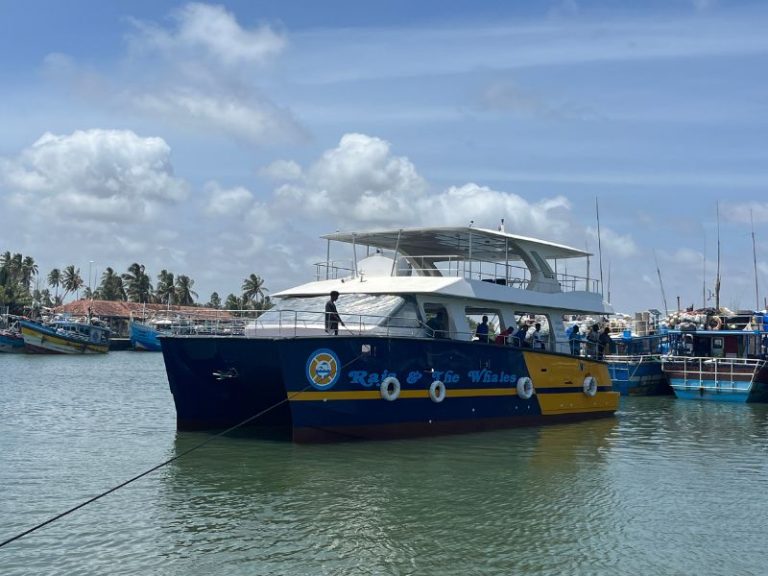
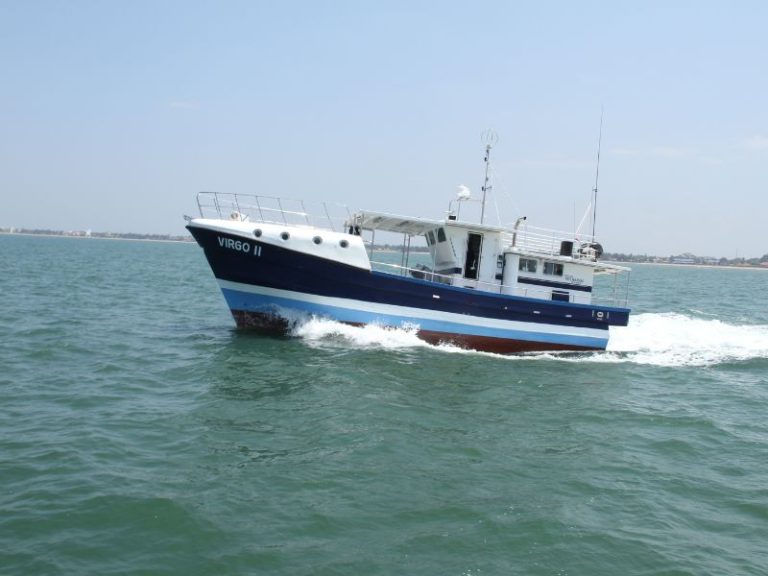
Proven Inboard Fishing Engine Configurations
Different commercial fishing vessels require different propulsion arrangements.
Neil Marine’s vessel portfolio provides several examples.
NMDF-40 Long-Line & Multiday Fishing Boat
The NMDF40 is a 12.3 metre commercial fishing vessel with a recommended 160 HP engine, 4,000 litres of fuel capacity and a loaded displacement of 28 tonnes. It has a stated range of 300 nautical miles and is described by Neil Marine as capable of remaining at sea for up to three weeks.
Its hull uses fiberglass construction reinforced with polyurethane foam transverse frames and glassed longitudinal structures.
There are some specifications that demonstrate how propulsion, fuel, payload, crew accommodation and fishing requirements are considered as one operational package.
58FT Long-Line Multi-Day Fishing Boat
At the larger end of Neil Marine’s fishing portfolio, its 58FT Long Line Multi Day Fishing Boat is specified with a 360 HP at 2,000 RPM inboard engine.
Its hull uses fiberglass construction with polyurethane foam transverse frames and glassed longitudinal reinforcement.
For fleet owners, the contrast between these two vessels demonstrates why engine selection cannot be separated from vessel size, displacement, range and fishing requirements.
Long Range Fishing Requires More Than Horsepower
When discussing long-range multi-day fishing vessels, horsepower often receives the most attention.
But range is influenced by much more than engine output.
Important factors include:
- Fuel tank capacity
- Engine efficiency
- Cruising speed
- Hull resistance
- Vessel displacement
- Propeller efficiency
- Sea conditions
- Payload
- Fishing method
- Operating profile
A commercial vessel designed for long-line tuna fishing, for example, may have very different requirements from a high-speed passenger craft.
The goal is generally to achieve the required operating performance without unnecessarily sacrificing range or carrying capacity.
Neil Marine’s NMDF-40 illustrates this principle. Its 160 HP recommended engine is paired with 4,000 litres of fuel, a 300-nautical-mile stated range and substantial fish, bait and slurry capacity.
The larger 58FT vessel moves to a 360 HP inboard installation alongside a 14,000-litre fuel capacity and 38 m³ fish hold.
Neil Marine Commercial Vessels: From Sri Lanka to Global Markets
Neil Marine’s commercial vessel experience is supported by more than five decades of boatbuilding.
The company states that it was founded in 1969, has delivered more than 40,000 boats globally and works with international partners and marine professionals. It also states that its production processes are managed in-house and that it holds Lloyd’s Approved Status while adhering to DNV and IRS classification standards.
Its commercial fishing range includes long-line and multiday vessels, while its wider portfolio covers workboats, research vessels, patrol craft, passenger vessels and other specialized marine applications.
This breadth is relevant to fleet owners because a commercial vessel is rarely defined by one component.
The hull, propulsion, electrical systems, fish-handling systems, accommodation and equipment must work together as one operational platform.